Edge Collective
A map of sensor communications
Every way we know of to get data out of a sensor, from RS-485 to meteor burst — and the constraint that's easy to forget, the expertise it takes to keep it running.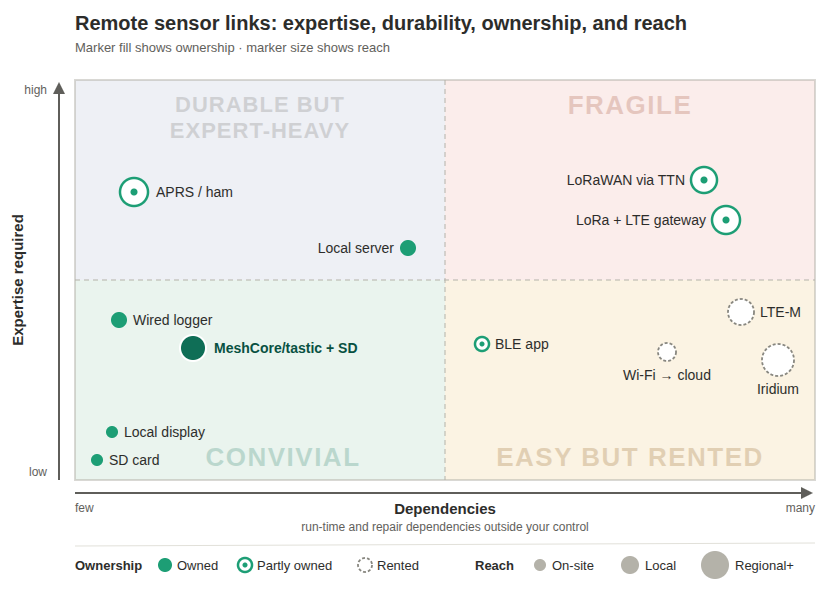
When we build a sensor (a water-level monitor, a greenhouse logger, an air-quality box), the measurement is often the easy part. The hard part is getting the data somewhere useful. This note is a broad map of the options, grouped by how the data physically travels, followed by the trade-offs we weigh when choosing.
The trade-off space
Every option below is a compromise among:
- range
- data rate
- power draw
- recurring cost (airtime or subscriptions)
- infrastructure you have to build
- latency
- licensing
- the expertise it demands from whoever keeps it running. This one is easy to leave off the list; see the hidden constraint below.
In practice, many real deployments are hybrids: a short-range or wired link carries data to a local gateway, and the gateway uses cellular, satellite, or a mesh for backhaul.
The full map
Wired (sensor to logger or gateway)
- RS-232 / RS-485, often running Modbus RTU: RS-485 is the industrial standard for long runs, up to about 1 km.
- SDI-12: the standard bus for environmental and hydrology sensors (soil moisture, water level, weather).
- 4–20 mA current loop: analog, very noise-tolerant, and common on industrial transducers.
- 1-Wire, I²C, SPI: short-distance board and bus protocols. 1-Wire can stretch to tens of meters.
- CAN bus: robust multi-drop bus used in vehicles and ag equipment.
- Ethernet / PoE: carries data and power on one cable, up to about 100 m per segment.
- Wired M-Bus: used for utility meters.
- Powerline communication: HomePlug, G3-PLC, and PRIME send data over the AC wiring you already have.
- Phone line / dial-up or DSL modem: legacy, but still found at remote stations.
- Fiber: immune to lightning and EMI, which matters for long runs between buildings.
Short-range wireless (meters to around 100 m)
- Bluetooth Low Energy, including advertising-only "beacon" mode that needs no connection. Bluetooth Classic is the older, higher-power version.
- Wi-Fi (2.4/5 GHz): high bandwidth but power-hungry.
- Wi-Fi HaLow (802.11ah): sub-GHz Wi-Fi with roughly 1 km range and low power.
- ESP-NOW: Espressif's connectionless peer-to-peer protocol. It's very low-latency and works without a router.
- Zigbee, Thread/Matter, Z-Wave: low-power mesh networks from home automation.
- ANT / ANT+: used in fitness and sports sensors.
- EnOcean: energy-harvesting, batteryless switches and sensors.
- NFC / RFID: tap-to-read, including passive sensor tags.
- UWB: mainly for ranging and location, with some data capability.
- Infrared / IrDA: line of sight. Utility meters still use optical IR ports.
- Simple ISM-band radios: 433/868/915 MHz modules (RFM69, CC1101) and 2.4 GHz nRF24. You write your own protocol.
LPWAN and long-range sub-GHz (kilometers, low data rate)
- Raw LoRa: point-to-point, your own protocol.
- LoRaWAN: star topology through gateways. You can run a private network or use The Things Network or Helium.
- Meshtastic / MeshCore: LoRa mesh with multi-hop relays. Our water-level sensors use MeshCore.
- Sigfox, now operated by UnaBiz: ultra-narrowband with tiny payloads.
- mioty, DASH7, Weightless: niche LPWAN standards.
- Wi-SUN: mesh used for utility smart grids.
- Wireless M-Bus: European metering standard.
- Amazon Sidewalk: piggybacks on Echo and Ring devices as gateways.
Cellular
- LTE-M (Cat-M1): low power, supports mobility and voice. It's a good default for IoT in the US.
- NB-IoT: even lower power, tiny payloads, and spottier US coverage.
- LTE Cat-1 / Cat-1bis: more bandwidth, for things like images.
- 5G RedCap: the newer mid-tier option.
- 2G/3G: shut down in the US, so avoid it.
- SMS: still a dead-simple transport on most modems.
- NTN (non-terrestrial network): cellular modems that fall back to satellite, such as Skylo.
Satellite
- Iridium SBD / Certus: truly global, including the poles, with short bursts and pricey airtime.
- Globalstar: simplex transmit-only units like SmartOne, plus duplex options.
- ORBCOMM, Viasat/Inmarsat: established commercial M2M providers.
- Myriota, Astrocast, Kinéis: low-cost, low-data IoT constellations. Kinéis also runs the Argos system used for wildlife tracking.
- LoRa-to-satellite: EchoStar Lyra, Lacuna, and similar.
- Starlink: a full broadband terminal, and power-hungry. Its direct-to-cell service is emerging.
- GOES DCS: a free US government channel for environmental and hydrology data. It needs agency sponsorship.
- Swarm: wound down after SpaceX acquired it. Check its status before designing around it.
Licensed, amateur, and other terrestrial radio
- APRS: VHF packet radio that carries telemetry frames. There is a big network of igates and digipeaters.
- AX.25 packet, VARA, Winlink: ham data modes.
- JS8Call, FT8, WSPR: HF weak-signal modes. WSPR is used for telemetry from high-altitude balloons.
- MURS: license-free VHF around 151–154 MHz, and data is permitted.
- Licensed VHF/UHF data radios (Part 90): SCADA-style links.
- Meteor burst: bounces signals off meteor trails. NRCS SNOTEL stations used it for decades.
- Point-to-point microwave: Ubiquiti, Mikrotik, and similar, for backhauling a remote site.
- TV white space: unused TV-band spectrum for rural links.
- HF NVIS: near-vertical skywave for regional coverage without line of sight.
On the ham bands, remember that encryption and commercial use are prohibited.
Optical, acoustic, and unusual
- Free-space optical / laser links: line of sight, high bandwidth.
- Li-Fi / visible light: data carried on modulated LED light.
- Acoustic modems: the standard for underwater sensors.
- Through-earth / VLF / magnetic induction: used in mines, caves, and buried sensors.
- Audio or ultrasonic tones: data over sound, sometimes picked up by a phone microphone.
Store-and-forward and "data mule"
- Manual retrieval: swap an SD card or download over USB.
- Phone or tablet passing nearby: BLE or NFC sync whenever someone visits.
- Drone or vehicle collection: a data mule flies or drives past and pulls data over Wi-Fi, BLE, or LoRa.
- Delay-tolerant networking: data hops opportunistically between nodes until it reaches a gateway.
- Human-readable output: a display, e-ink screen, or QR code someone photographs, or a dial that someone writes down.
Opportunistic / crowdsourced networks
- Apple Find My / Google Find My Device: OpenHaystack-style tricks can smuggle a few bits per hour through millions of phones.
- Community LoRaWAN: TTN and Helium gateways you didn't deploy yourself.
- Someone else's Wi-Fi or mesh: with permission, for example a neighbor's network or a farm's existing infrastructure.
How we tend to choose
A few questions settle most cases:
- Does anyone need the data in real time? If not, a data mule or SD card is cheap, reliable and needs no infrastructure at all.
- Is there power? On batteries or a small solar panel, rule out Wi-Fi and Starlink early; LoRa, BLE and LTE-M stay in.
- Is there coverage, and who owns it? Cellular and satellite depend on someone else's network and a subscription. A LoRa mesh is infrastructure you can build and keep yourself.
- How far, and over what terrain? Hills and trees favor sub-GHz LoRa and HF over 2.4 GHz.
- Who will maintain it? The best link is the one the people on site can understand and fix. This question deserves a section of its own.
The hidden constraint: expertise
There's a well-known trap when technologists choose technology for other people: the curse of knowledge. Once you know something, it's very hard to imagine not knowing it, so you underestimate how hard it is for everyone else. A few close relatives:
- Expert blind spot (Nathan and Petrosino): experts can't see the steps they no longer consciously take. This is the most precise fit.
- Tacit knowledge (Michael Polanyi): "we know more than we can tell." Much of what makes a LoRa node feel "easy" is invisible skill: reading a datasheet, knowing which forum to trust, telling a brownout from a firmware bug.
- Unconscious competence: the last rung of the competence ladder, where you've forgotten you ever had to learn the thing.
Making it an engineering constraint
The way to raise this with technologists is to turn it from a soft concern into a design constraint. Engineers already respect failure modes, specs and dependency chains.
- Count the knowledge stack, not just the parts list. A bill of materials lists hardware. A skill BOM lists everything someone must know to keep the system running: soldering, a toolchain, Linux, the cloud dashboard, the API that changed last year. Each item is a dependency, and dependencies fail.
- Design for the maintainer, not the builder. The relevant user is whoever fixes it in February, three years from now, after you've moved on.
- Run the walk-away test. If the designer disappears tomorrow, does the system keep working for a year? It's a version of the "bus factor" engineers already know.
- Set a skill floor. Name the least-trained person who should be able to diagnose a failure, and make that a spec. "A 12-year-old with a multimeter can tell whether it's power, radio or sensor" is a requirement you can test against.
- Treat legibility as a feature. A status LED, labeled connectors, and a paper troubleshooting card taped inside the enclosure. A failure people can see is one they can fix.
- Degrade gracefully, and prefer repair to replacement. If the gateway dies, data should keep logging locally to an SD card.
- Count the recurring dependencies. Subscriptions, cloud accounts, proprietary apps and vendor lock-in are maintenance liabilities with an expiration date, even if no one is watching it yet.
- Start small and working. Gall's law: complex systems that work evolved from simple systems that worked. That's a good argument against deploying the elegant mesh on day one.
The chart at the top of this note is built around this idea: the skill a system demands often matters more than its range or data rate.
Readings
- Appropriate technology: E.F. Schumacher, Small Is Beautiful.
- Tools for Conviviality: Ivan Illich's idea that a good tool expands the user's autonomy rather than making them depend on experts. This is probably the sharpest frame for community infrastructure.
- The Innovation Delusion and the Maintainers network: Lee Vinsel and Andrew Russell's argument that we chronically overvalue building and undervalue maintenance.
- "Pilotitis" in ICT4D: development-sector research on why tech pilots succeed, then die when the funded experts leave.