Edge Collective
Mesh Water Level
A solar-powered ultrasonic water level sensor that sends readings over a MeshCore LoRa link to a WiFi gateway and logs them to Bayou. Full parts list, wiring, and setup.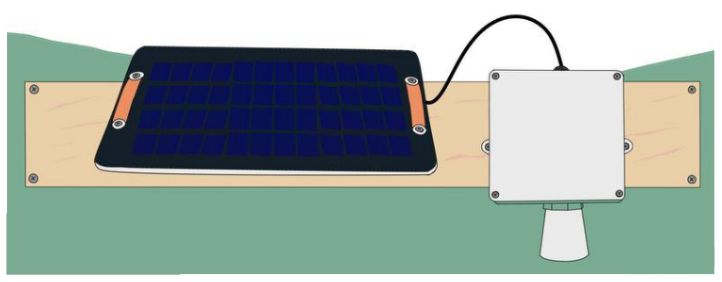
Illustration courtesy Jacob Lloyd
Problem Statement
We'd like to provide real-time alerts about local water levels and flooding conditions to rural areas, using technology that is accessible, inexpensive, and easy to deploy and repair locally.
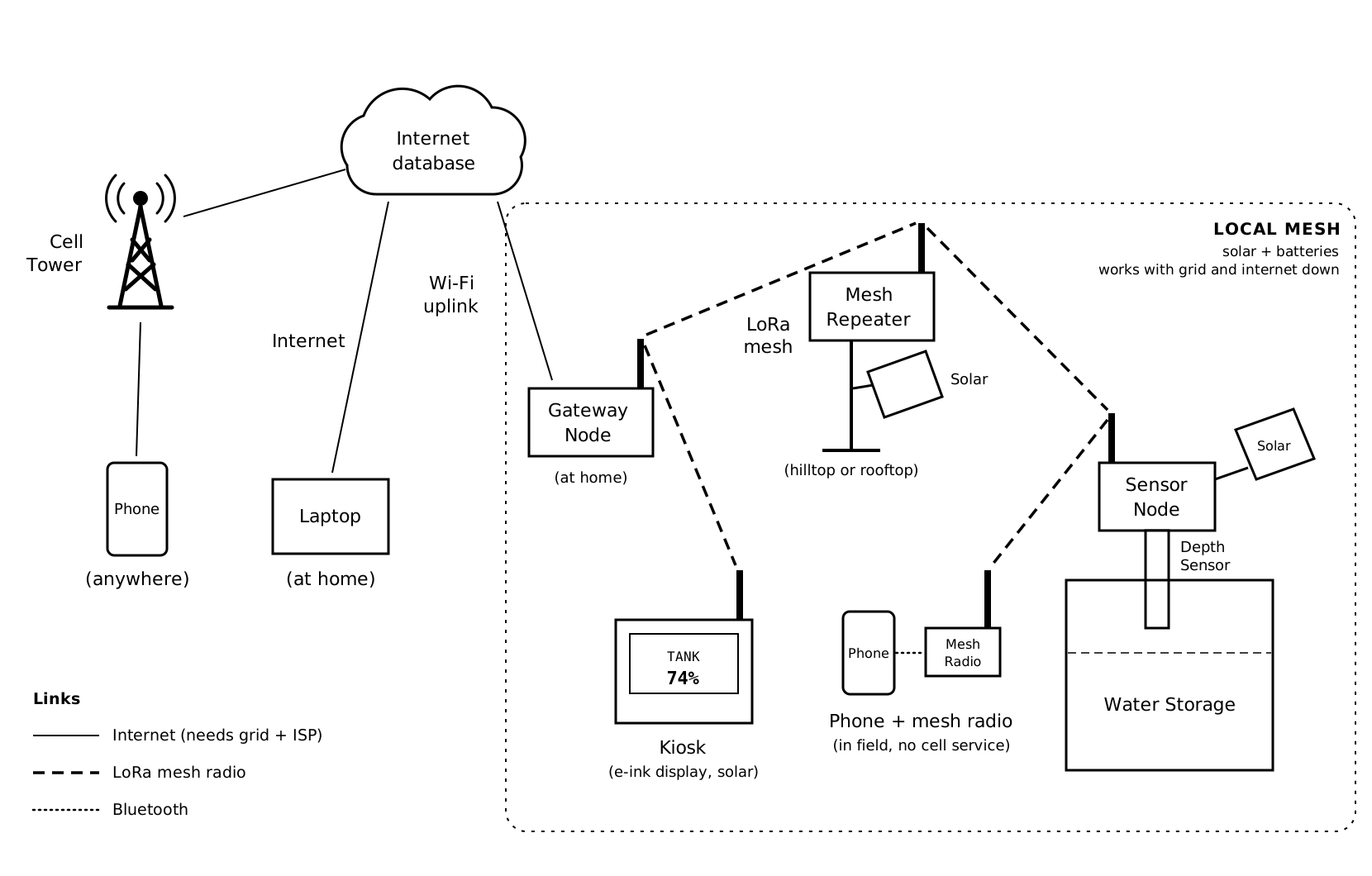
One reason we're excited about mesh radio in particular is that it's increasingly widely adopted, and it opens up overlapping use-cases. The same network that carries water-level readings can also carry text messages between neighbors, readings from other sensors, and emergency communications when the power or internet is down. When a network is useful for many things, more people have a reason to keep it running, which makes ongoing community maintenance more likely.
Design Considerations
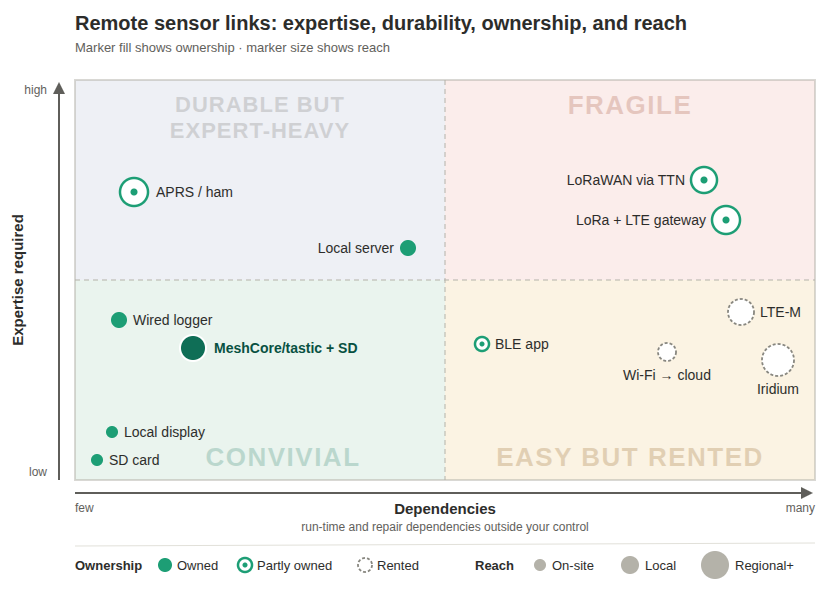
Where this design sits among other ways of getting data out of a sensor. More in our research note, A map of sensor communications.
 |
|---|
| The sensor node sits on a local LoRa mesh. Readings reach the internet through a gateway at home, and they can also be read locally, on a kiosk or a phone with a mesh radio, when the grid or internet is down. |
Current Approach
A solar-powered ultrasonic sensor that measures the distance down to a water surface, radios it over a MeshCore LoRa link to a WiFi gateway, and logs it to Bayou. It works where there's no cell service or WiFi at the water's edge.
Illustration courtesy Jacob Lloyd
The system is two devices:
- Sender. A weatherproof box over the water holds a Rook v4 board and a lithium battery charged by a small 5 V solar panel. A MaxBotix MB7383 ultrasonic rangefinder threads through the bottom of the box and points straight down. On a timer (every 5 minutes by default), the Rook reads the distance and transmits it with its battery voltage.
- Receiver. A Heltec WiFi LoRa 32 (V3 or V4) sits indoors within WiFi range. It acknowledges each reading and posts it to a Bayou feed. The LoRa link can span a few hundred metres to a few kilometres, depending on terrain and antennas.
The full build recipe covers:
- A full bill of materials, with where to buy each part and approximate prices
- Three ways to get a Rook: assembled, bare PCB, or built from the open design files
- Wiring diagrams for the sensor node
- Mounting over the water
- Gateway setup, plus flashing both devices from the browser
A ready-to-deploy version is available as the Mesh Radio Water Level Kit.
Firmware
The firmware is documented at edgecollective/MeshCore-simple-sensor: how it works, how readings reach Bayou, and how to flash and configure both devices from the browser.